
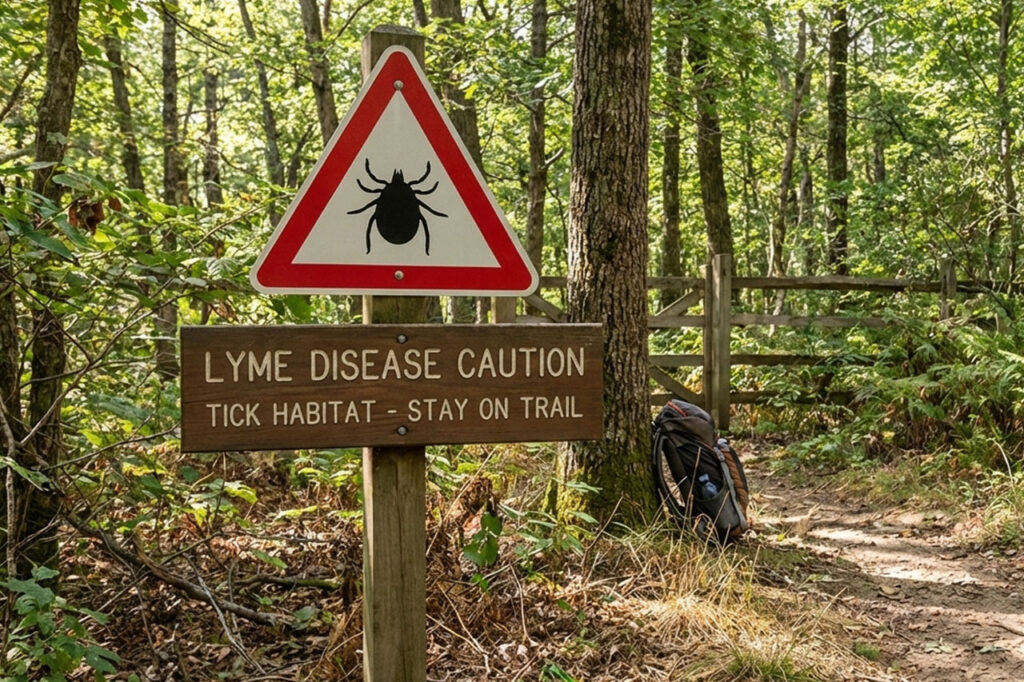
Picture this, you’re hiking through New England forests, and two weeks after returning home to Australia, you notice an expanding red rash. Can you get Lyme disease while travelling? Yes, and it’s more common than many Australian travellers realise.
Lyme disease is a tick-borne infection caused by Borrelia burgdorferi, contracted through infected ticks in the Northern Hemisphere. While Australians face virtually no risk at home, travelling to endemic areas exposes you to genuine infectious threat requiring awareness and prevention.
This lyme disease travel guide equips Australian travellers with knowledge on preventing infection, recognising symptoms, and seeking treatment promptly.
What is lyme disease?
Lyme disease is an infectious illness transmitted when an infected tick attaches to skin and feeds. The causative agent, Borrelia burgdorferi, is a bacterium living in certain tick species, particularly Ixodes ticks (deer ticks).
Recent research has challenged traditional assumptions about transmission time. While North American strains typically require 36–48 hours, European strains can transmit within 12–24 hours, and no absolutely safe minimum attachment time has been established. The bacterium migrates to salivary glands and enters the host. Research indicates that partially fed ticks may transmit Lyme disease upon reattachment, though the exact timing remains variable depending on bacterial strain and tick species.
Lyme disease causes no immediate pain or obvious symptoms. Most people don’t realise they’ve been bitten. Symptoms, particularly the characteristic erythema migrans rash, appear 3–30 days later, often after returning home. This delayed presentation makes prevention and post-travel awareness critical.
Is lyme disease a risk in Australia?
Lyme disease does not occur naturally in Australia. The bacterium is not found in Australian ticks or insects. However, most Lyme disease cases in Australian patients are travel-related. Australians bitten by infected ticks in endemic regions can contract and bring Lyme disease home. The disease cannot transmit person-to-person. Australian healthcare providers can fully diagnose and treat lyme disease Australia cases contracted overseas though delayed recognition may occur without explicit travel history due to low clinical familiarity..
High-risk travel destinations for lyme disease
North America
The highest concentration occurs in the northeastern United States (New England region), the upper Midwest, and Atlantic coastal regions. The disease is also present in parts of the Pacific Northwest and western coastal areas, though less commonly than in the Northeast.
Europe
Central and Eastern European countries carry significant risk, including the United Kingdom, Scandinavia, and countries across central Europe. Parts of Russia also have documented Lyme disease.
Tick season by region
Tick activity varies by latitude and climate. In the Northern Hemisphere, peak tick season occurs during spring and summer (April–October), with highest activity May–July. However, ticks remain active in autumn if temperatures remain mild, and even in winter in milder climates. Australian travellers visiting during their winter (Northern Hemisphere summer) face maximum exposure risk.
Pre-travel preparation: your lyme disease prevention checklist
Research your destination
- Determine if your destination is in endemic Lyme disease areas
- Contact local health departments or travel clinics for current tick activity
- Identify high-risk locations (forests, grasslands, wooded trails)
Pack the right protection
- DEET or picaridin insect repellent (20–30% concentration)
- Permethrin-treated clothing (pre-treat before travel or buy treated garments) – provides superior protection by killing ticks on contact
- Light-coloured long sleeves, trousers, hat (easier to spot dark ticks)
- Fine-tipped tweezers for safe tick removal
- First aid supplies: rubbing alcohol, iodine scrub, antiseptic wipes
Travel insurance considerations
- Confirm coverage for tick-borne illnesses including Lyme disease
- Verify medical consultations and testing are covered abroad
- Store emergency contact numbers for travel clinics and hospitals
During your trip: Practical prevention strategies
Clothing and protection
Wear long-sleeved shirts and full-length trousers in tick habitats. Tuck your shirt into your trousers and trousers into your socks to prevent tick access. Choose light colours to easily spot dark ticks. Apply DEET repellent (20–30%) to exposed skin. Wear permethrin-treated clothing for additional protection, it kills ticks rapidly through contact.
Avoiding tick habitats
Stay on cleared trails as ticks congregate on adjacent vegetation. Avoid tall grass and brush where ticks rest 15–100 centimetres above ground. Be cautious in wooded areas as deciduous and mixed forests have higher tick densities. Shower within two hours of outdoor exposure and wash clothes in hot water to kill any ticks.
Daily tick checks
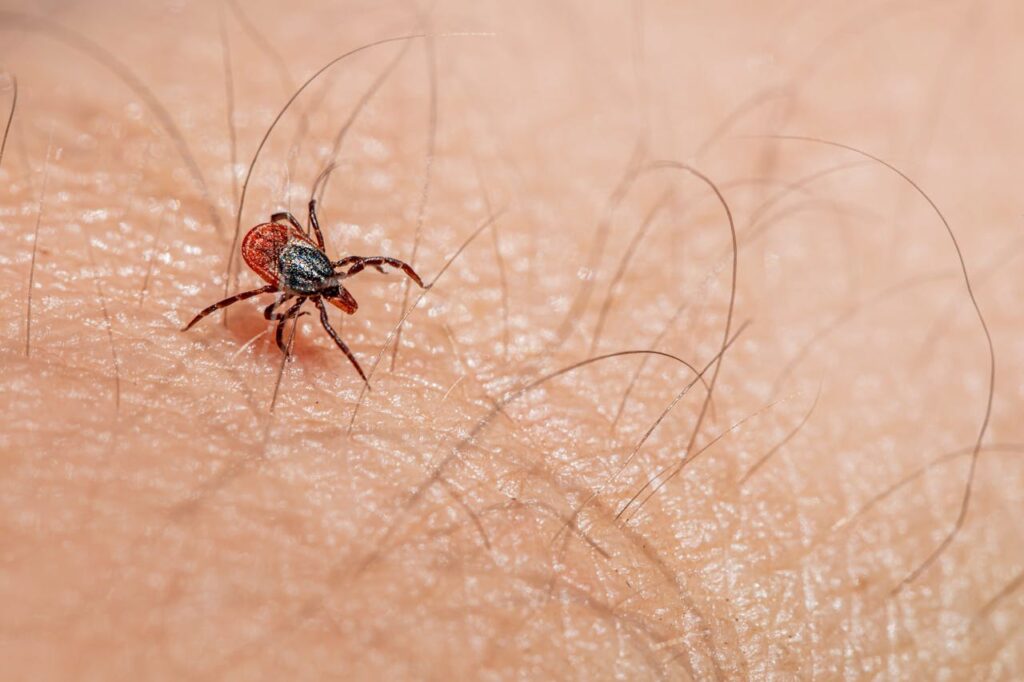
Perform thorough daily visual inspections of tick-prone areas including behind ears, neck/hairline, groin, armpits, back of knees, belly button, and between legs/buttocks. Early-stage ticks appear as small dark specks or sesame-seed-sized protrusions. Nymph ticks (poppy-seed sized) are nearly invisible but are your primary concern for Lyme transmission. What do tick bites look like initially? Often like nothing—ticks cause no pain or itching, making visual inspection critical.
What to do if you’re bitten: Immediate action steps
Step 1: Remove the tick safely
Remove immediately regardless of how long you think it’s been attached, no safe minimum time has been established. Use fine-tipped tweezers to grasp the tick close to skin. Pull upward with steady, even pressure without twisting, jerking, or squeezing. Remove the entire tick, including all mouth parts. Clean the bite area with rubbing alcohol or antiseptic wipe. Do not use petroleum jelly, heat, essential oils, or folk remedies, these cause ticks to regurgitate infectious material.
Step 2: Document the bite
Take clear photos of the tick and bite location. Note the date, time, and specific location where the bite occurred. Keep the tick in a sealed container, medical professionals can identify the species to determine infection risk. Dispose of live ticks by submersing in alcohol or flushing down the toilet.
Step 3: Monitor for symptoms
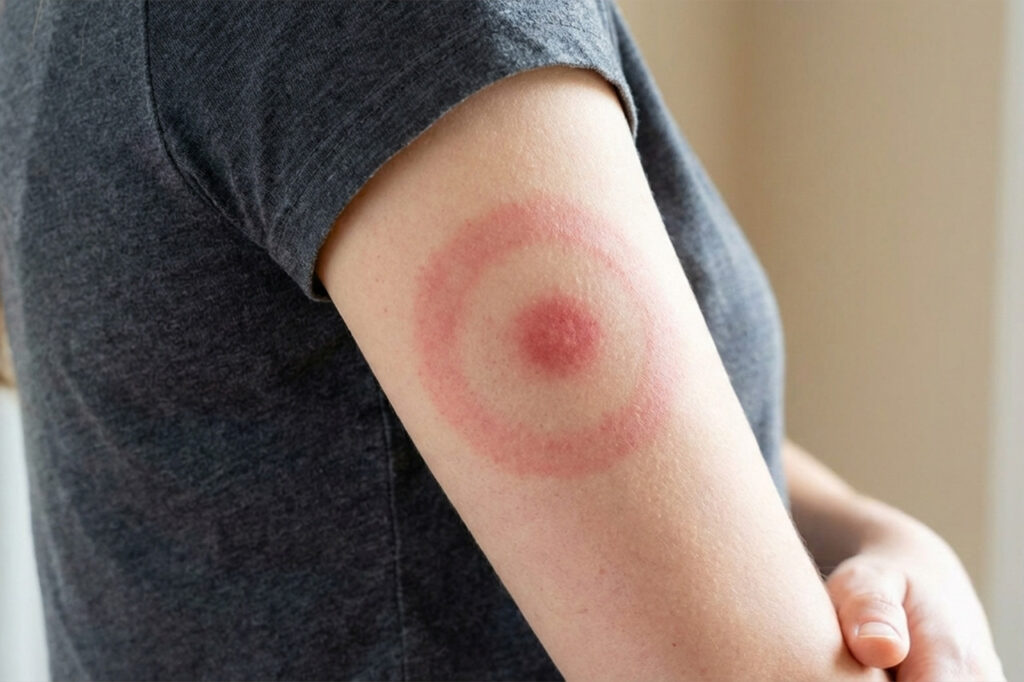
Watch for early symptoms over the next 30 days. The erythema migrans rash appears in 27-80% of infections, typically 3 to 30 days after the bite. The classic bull’s-eye appearance is rare, with most rashes presenting as solid red areas. Monitor for flu-like symptoms including fever, chills, fatigue, headache, and muscle aches. On tick bite day 1, you won’t experience symptoms; infection takes time to develop.
Recognising lyme disease symptoms while travelling
Early stage symptoms (3–30 days)
The erythema migrans rash appears in approximately 27-80% of infected individuals. It begins as a small red circle and expands in diameter. Fever, chills, and profound fatigue commonly accompany the rash. Headache and generalised muscle aches are typical. Lymph node enlargement may occur.
When to seek medical attention
Any expanding red rash 3–30 days after a tick bite warrants immediate medical evaluation. If you develop fever, headache, and muscle aches after a tick bite in an endemic area, seek medical attention. Do not wait for a bull’s-eye pattern, most rashes lack central clearing. If still travelling, visit a local travel clinic or hospital immediately rather than waiting until return.
Post-travel: what to do when you return home
Continue monitoring
Lyme disease symptoms can appear weeks after initial infection, not just within the first month. Maintain your photographic documentation and symptom timeline. Be aware of late-stage symptoms if untreated: Lyme arthritis (joint swelling and pain), neurological symptoms (meningitis, facial nerve paralysis), and cardiac complications.
See a doctor in Australia
Present to your GP or travel clinic if symptoms develop within 30 days of returning from an endemic area. Even without symptoms, inform your healthcare provider if you were bitten in a high-risk area. Bring your documentation and be specific about regions visited.
Treatment options
Lyme disease treatment is highly effective when initiated promptly. Antibiotics started within days of symptom onset show strong clinical efficacy with high treatment success rates.
Standard oral antibiotic regimens for early disease typically include:
- Doxycycline: 100mg twice daily or 200mg once daily for 10 days (preferred for most adults)
- Amoxicillin: 500mg three times daily for 14 days
- Cefuroxime axetil: 500mg twice daily for 14 days
Early treatment prevents disseminated disease and serious complications. If Lyme disease progresses to neurological, cardiac, or arthritic manifestations, longer courses (14–28 days) or intravenous antibiotics become necessary.
Special considerations for Australian travellers
Most Australians have zero prior exposure to Lyme disease or tick prevention knowledge. Unlike North Americans or Europeans, Australian travellers often lack foundational understanding of tick risks.
Australian healthcare providers, whilst fully capable of diagnosing and treating Lyme disease, rarely encounter it. This can lead to delayed recognition without explicit mention of travel history and tick exposure.
For Australian travellers, prevention is paramount. Protective clothing, repellents, daily tick checks, and post-travel monitoring directly prevent infection.
FAQ
No. Current evidence indicates classic Lyme disease is not endemic in Australia, and health authorities consider almost all confirmed Lyme cases in Australians to be acquired overseas.a
Symptoms typically appear 3–30 days after bite, with average onset around 7 days. The most common sign is an expanding erythema migrans rash. Tick bite day 1 may show no obvious signs. Post-travel monitoring for 30 days is essential.
Remove it immediately with fine-tipped tweezers. Grasp close to skin and pull upward with steady, even pressure. Do not twist, jerk, or squeeze. Clean the bite area with rubbing alcohol or antiseptic wipe. Document with a photograph. Monitor for an expanding rash or flu-like symptoms over 3–30 days and seek medical attention if symptoms develop.
Yes, Lyme disease is highly treatable when diagnosed early. Standard oral antibiotics like doxycycline, taken within days of symptom onset, show strong clinical efficacy with high treatment success rates. Early treatment prevents serious complications including neurological symptoms, arthritis, and cardiac issues. Treatment becomes more complex if the disease progresses to later stages.
Early-stage Lyme disease typically requires 10-14 days of oral antibiotics, with doxycycline (100mg twice daily) being the preferred treatment for most adults. If the disease progresses to neurological, cardiac, or arthritic manifestations, treatment extends to 14-28 days or may require intravenous antibiotics. Prompt treatment initiation improves outcomes significantly.
Untreated Lyme disease can progress to serious complications including Lyme arthritis with joint swelling and pain, neurological symptoms such as meningitis and facial nerve paralysis, and cardiac complications. These late-stage symptoms can develop weeks or months after initial infection, making early diagnosis and treatment critical for preventing long-term health issues.
No, only bites from infected ticks transmit Lyme disease. The bacterium Borrelia burgdorferi must be present in the tick, and transmission risk varies by region and tick species. Not all ticks carry the infection, and even infected ticks may not transmit if removed quickly. However, since you cannot determine if a tick is infected, treat all tick bites as potentially infectious and monitor for symptoms.